Scott Ewings Chairs Packed Accessibility Panel at Bath Digital Festival
|6 min read

What if we built digital experiences that truly include everyone?
We posed this question to a panel at Bath Digital Festival, and came to some conclusions with help from the audience. Read on to find out more.
Every single year, the UK economy loses a staggering £17 billion to digital exclusion. Let that sink in for a second. In a world where banking, utilities and just staying in touch has largely moved online, exclusion isn’t just user experience friction, it’s a systemic barrier that cuts people off from their fundamental rights.
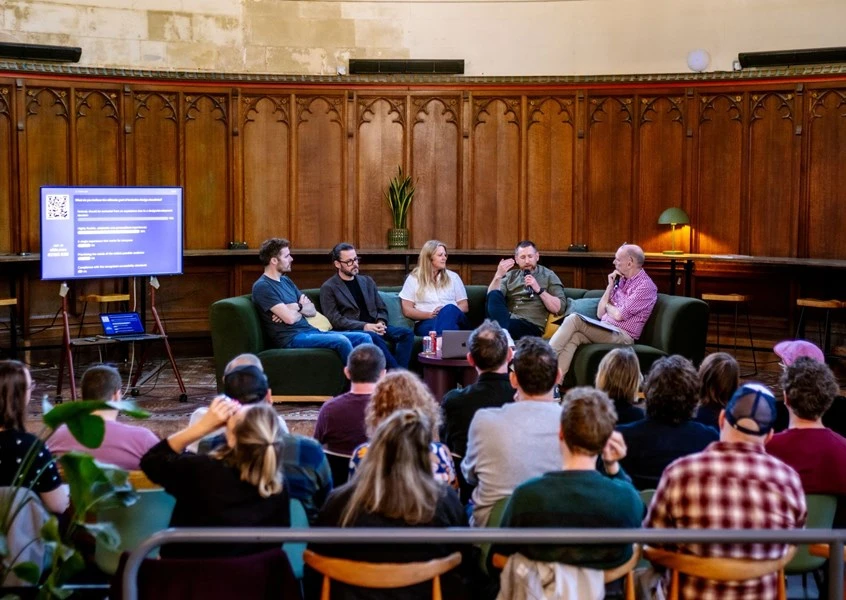
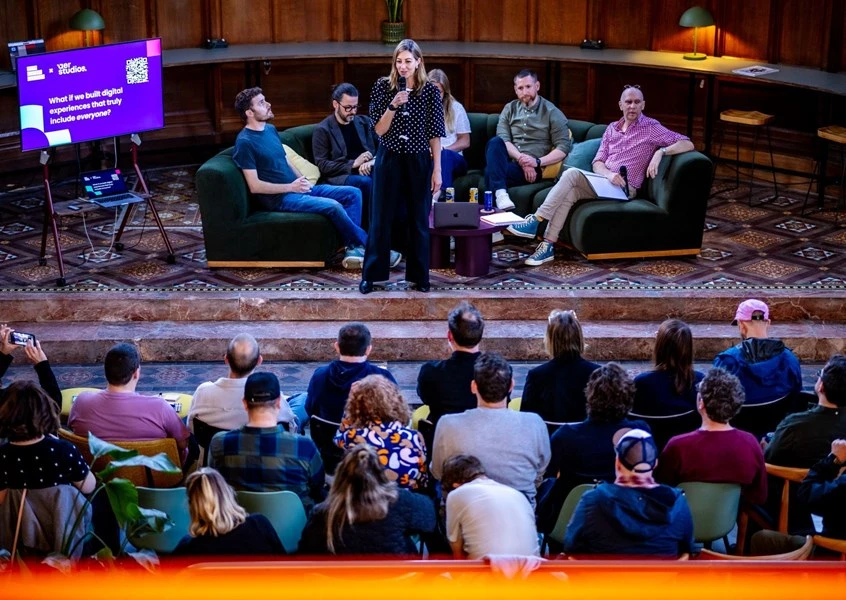
At our recent panel event for the Bath Digital Festival, we gathered a panel of industry leaders to interrogate a seemingly simple question: What if we built digital experiences that truly include everyone?
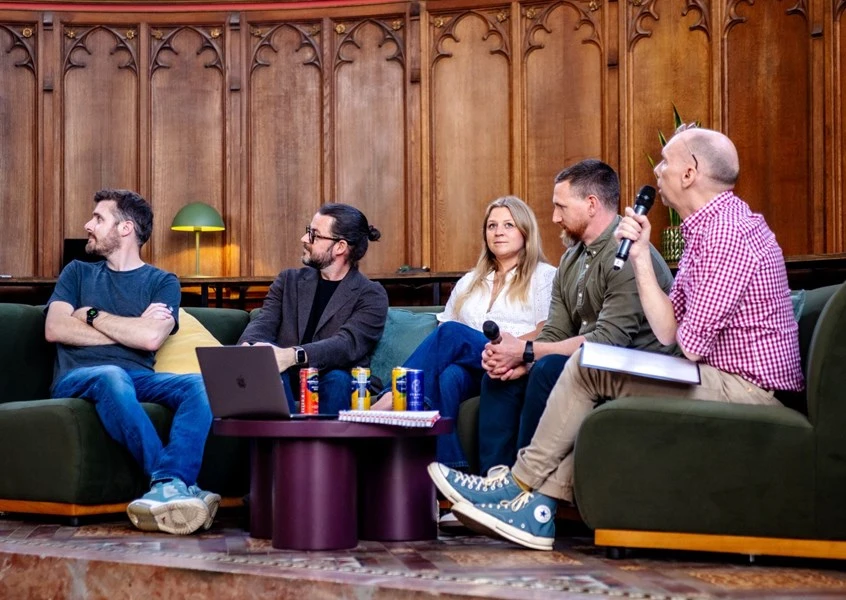
Facilitated by our Chief Strategy Officer, Scott Ewings, the panel brought together:
-
Lucy Collins, Managing Director of Web Usability and Co-Founder of collectively
-
Mo Morgan, Co-Founder and Chief Strategy Officer of Lumino
-
Matt Roberts, Senior UX Designer and BIMA Inclusive Design Council Co-Chair
-
James Hobbs, Chief Technology Officer at Aer Studios.
What followed was a sharp, occasionally ‘pointy-elbowed’ debate that moved far beyond standard compliance checklist platitudes. It dug into the psychological barriers halting progress, the messy reality of AI, and the tangible steps required to build more equitable digital experiences.
Defining success: Is fully inclusive even possible?
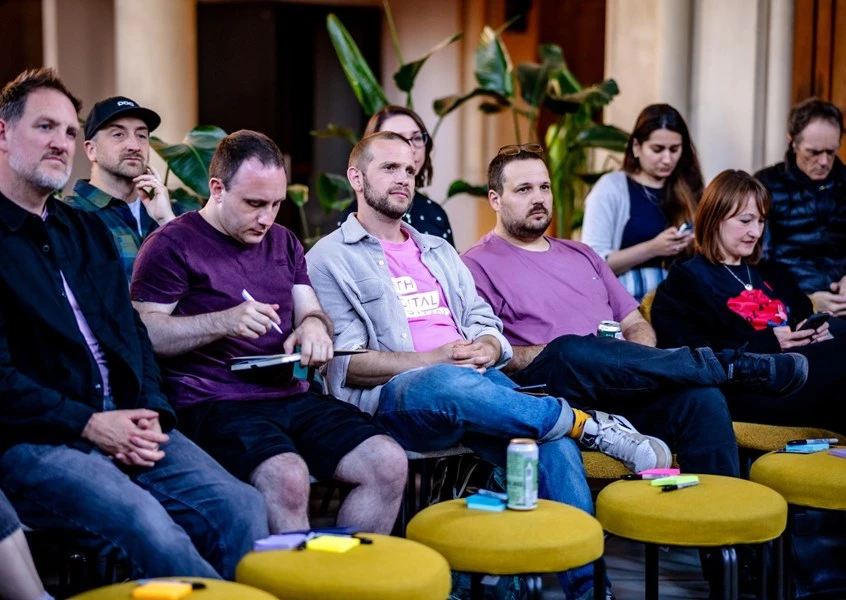
We opened the debate by gauging the philosophy of the room, asking our live audience via Slido what they believed the ultimate goal of inclusive design should be.
WHAT SHOULD THE ULTIMATE GOAL OF INCLUSIVE DESIGN BE?
Nobody excluded due to a design/development decision 55%
Highly flexible, adaptable, and personalized experiences 36%
Prioritising the needs of the widest possible audience 5%
A single experience that works for everyone 5%
Compliance with recognised accessibility standards 0%
The results were telling. More than half the room agreed that nobody should be excluded from an experience due to a design or development decision, while strictly chasing compliance with standard guidelines didn’t get any votes. The industry is clearly ready to move past tick-box exercises, but what does executing that look like in practice?
Moving beyond the average user
The consensus was clear, there’s no such thing as an average user. Individuals show up to apps and websites with different goals, unique physical or neurodiverse traits and varying levels of digital confidence - not to mention the situational contexts of daily life. A single, static asset can never truly serve everyone, so the future has to be about flexibility and deep personalisation.
James Hobbs pointed to a fascinating (and slightly terrifying) glimpse of where things are heading through Android’s recent experiments with natural language ‘vibe-coding,’ which lets users build custom widgets on the fly just by talking to their phone.
“My dream would be, as an individual, that across devices I have some sort of statement that says ‘These are the things that matter to me, this is how I like to interface with things, this is how I like to interact’, and that’s something that can be used across all the different digital services that I use and they adapt automatically,” James noted.
Building for belonging
Lucy Collins reframed this technological shift through a human psychological lens, advocating for the expansion of the classic acronym to DEI (Diversity, Equity and Inclusion) to become DEIB, where ‘Belonging’ makes up the final piece of the equation.
In user testing settings, Lucy has observed users with severe accessibility constraints struggle through agonising interface frictions, yet state at the end that the experience was fine simply because they managed to complete their task. True inclusion eliminates that struggle by creating spaces where marginalised audiences don’t feel like an afterthought, but feel inherently seen and safe.
Breaking down barriers
If the human and economic benefits are so glaringly obvious, why is the web still so broken for so many people? Our second audience poll looked at the dominant root causes.
WHAT IS THE BIGGEST BARRIER PREVENTING BUSINESS-AS-USUAL INCLUSION?
Lack of leadership advocacy 45%
Knowledge and skills deficits 36%
Lack of budget 14%
Lack of a commercial benefits case 5%
Fear of getting it wrong 0%
The room identified lack of leadership advocacy (45 per cent) and knowledge gaps (36 per cent) as the primary roadblocks. Lucy shed light on why corporate structures default to avoidance, identifying a phenomenon she calls the ‘accessibility hot potato.’
Because digital accessibility regulation is often framed punitively by governing enforcement bodies, it introduces an undercurrent of corporate anxiety. Senior management views accessibility through a lens of legal liability rather than human utility. Executives pass the responsibility down to delivery leads, delivery leads pass it to external agencies and agencies deflect it back to corporate decision-makers.
When this happens, we completely dehumanise the conversation. When the executive tier lacks lived experience or personal proximity to disabled users, a quiet process of ‘othering’ takes over. Accessibility ends up being treated as a specialised, high risk feature to outsource rather than a fundamental design baseline.
Following the money
Mo Morgan challenged the panel to look at structural economics. Corporate leaders rarely ignore inclusion out of malice - they do it because standard business metrics are terrible at connecting empathy to immediate profit .
To prove his point, Mo highlighted WhatsApp as a spectacular example of an inclusive digital product. It works on low-end legacy hardware, bridges flaky global networks and its text-and-voice layout is inherently friendly for various neurodivergent traits and motor skills.
WhatsApp is built this way because its parent company’s business model depends entirely on capturing the widest possible global user footprint, so mass inclusion is its revenue engine. But as Mo pointed out, if you’re a standard business making water pumps in a local town, the executive brief rarely starts with how to design for the 22 per cent of the population living in relative poverty. To shift corporate behaviour we have to learn to talk about inclusion in the commercial language leaders understand.
The paradox of AI: catalyst or barrier?
The conversation turned sharply toward AI. In 2026 generative AI dominates every conversation about software delivery, but our panel was divided on whether it represents a democratisation of access or whether it automates exclusion at lightning speed.
WHAT IS AI’S POTENTIAL ROLE IN INCLUSIVE DESIGN?
Useful, but strictly requires human oversight 30%
It is way too early to tell! 30%
Risks scaling and automating inaccessible experiences 22%
Will reinforce and hardcode existing societal biases 9%
Will dramatically improve accessibility and inclusion 9%
Mo took an uncompromising stance, arguing that under current commercial frameworks AI is fundamentally incompatible with true inclusion.
“When we talk about AI today, we aren’t just discussing code, we’re discussing an incredibly consolidated tech industry controlled by an elite group of corporate entities,” Mo argued. “These systems are trained on historical data assets that are inherently exclusionary. Left unchecked, they automate inequality at a scale we have never seen before.”
Mo compared the current AI hype to the early days of social media. What began as an idealistic, decentralised medium for human connection (‘microblogging’) was entirely consolidated within 15 years into an optimised infrastructure for societal attention capture. He warned that handing inclusive design entirely over to automated models is the equivalent of handing dangerous surgical instruments to unregulated actors.
James and Lucy offered a more optimistic opinion. They pointed out that a vast amount of AI tech is completely open source, giving independent, passionate creators massive leverage to build specialised tools away from corporate monopolies.
However, they warned that while AI can make it easier and cheaper to build deeply adaptable interfaces, the real trap is the economic pressure it creates downstream. AI makes building software look deceptively instant, leading to organisations shortening timelines and slashing budgets. This devalues the time it takes to conduct the human-centred research that’s needed to ensure a product actually works for real people.
Shifting the dial
How do design and development teams break this cycle of this inertia and avoid dipping into empathy fatigue? Our final audience poll asked what tactical changes would most effectively improve digital inclusion outcomes.
WHAT WOULD BEST IMPROVE INCLUSIVE OUTCOMES IN DEVELOPMENT?
Integrate users with lived experience directly into delivery 75%
Ensure shared accountability across design & dev disciplines 10%
Secure stronger executive corporate sponsorship 10%
Implement better testing tooling and automated checkers 5%
Better corporate training and capability building 0%
An overwhelming 75 per cent of the audience stated that integrating users with lived experiences directly into active product design and development cycles is the single most powerful lever to pull.
True inclusion requires ‘shifting left’ or moving accessibility consideration from a pre-launch QA check to an initial project discovery constraint.
The panel outlined the core tenets of making a shift-left strategy successful:
-
Leverage universal design frameworks: Universal design principles are mature, well-documented and structured. Use them as starting constraints, not optional optimisations.
-
Compensate lived-experience co-designers: Don’t ask disabled colleagues or users to critique your layout assumptions in their spare time. Pay them expert consulting rates for their specialised insights.
-
Acknowledge and design for marginalised contexts: Look closely at hidden use cases. Cognitive conditions like dementia were highlighted as a stress test for digital inclusion. When you build an interface that accommodates progressive short-term memory loss and fluctuating focus, you naturally build cleaner, sturdier software that is infinitely better for everyone.
Defeating empathy fatigue
If you’re the lone advocate banging the drum for accessibility inside a large company, it can feel like trying to push water uphill. Matt Roberts shared a powerful perspective on building a sustainable culture of advocacy from the ground up.
“If you attempt to fight the battle as a single developer or designer against an entire corporate army, you will burn out,” he warned. “You have to change your tactics. Stop sending long compliance reading lists on Slack that nobody opens. Instead spark small, experiential moments of friction.”
Matt suggests bringing project managers, account handlers and executives into active user testing sessions, and having teams try to navigate their own creations using screen readers or native accessibility settings. These direct human encounters create the ‘eureka moments’ that break through corporate silos and turn passive awareness into active allyship.
Allyship remained a common theme throughout the evening, with the panel also advocating for people to educate themselves in order to support and represent communities. Within the room, there was enthusiasm for understanding and advocating for inclusion.
Our collective commitment
At the close of our panel discussion, our audience committed to concrete, personal actions to change their daily practices. These included vows to ‘challenge the money people,’ ‘think about accessibility from the very start,’ and ‘stop treating inclusion as a negotiable line-item.’
Digital inclusion isn’t a coding problem to throw an automated algorithm at or a legal liability checklist to pass down the food chain. It’s a continuous, intentional human practice of empathy, engineering discipline and commercial clarity.
The tech tools at our disposal are incredibly powerful. The choice is entirely ours to bring lived-experience voices into the room, stand shoulder-to-shoulder as teams and build a digital world where everyone truly feels at home. We plan to reconvene with the panel and attendees in a few months so we can see how we’ve all performed against the commitments set out at the event.
Because in the end, this stuff matters.
Before you go, here’s a snapshot of the commitments made, both large and small on the evening:
-
Challenge the money people
-
Keep banging the drum
-
Be intentional and consistent
-
Break the cycle of reinforcing biases via AI
-
Commit to finding out how our company can do more
-
Write something for our NHS colleagues on designing for accessibility
-
Review our online content to make sure we’re not failing on accessibility standards
-
Try and learn more about where we lack inclusivity and build it in
-
Map out the accessibility space to help companies reduce barriers to accessibility for companies
-
Think about accessibility from the start
-
Dig my heels in